Anthropic has published research, which analyses the impact of artificial intelligence on the labour market, and I've translated the pictures into Russian for you. and drew conclusions
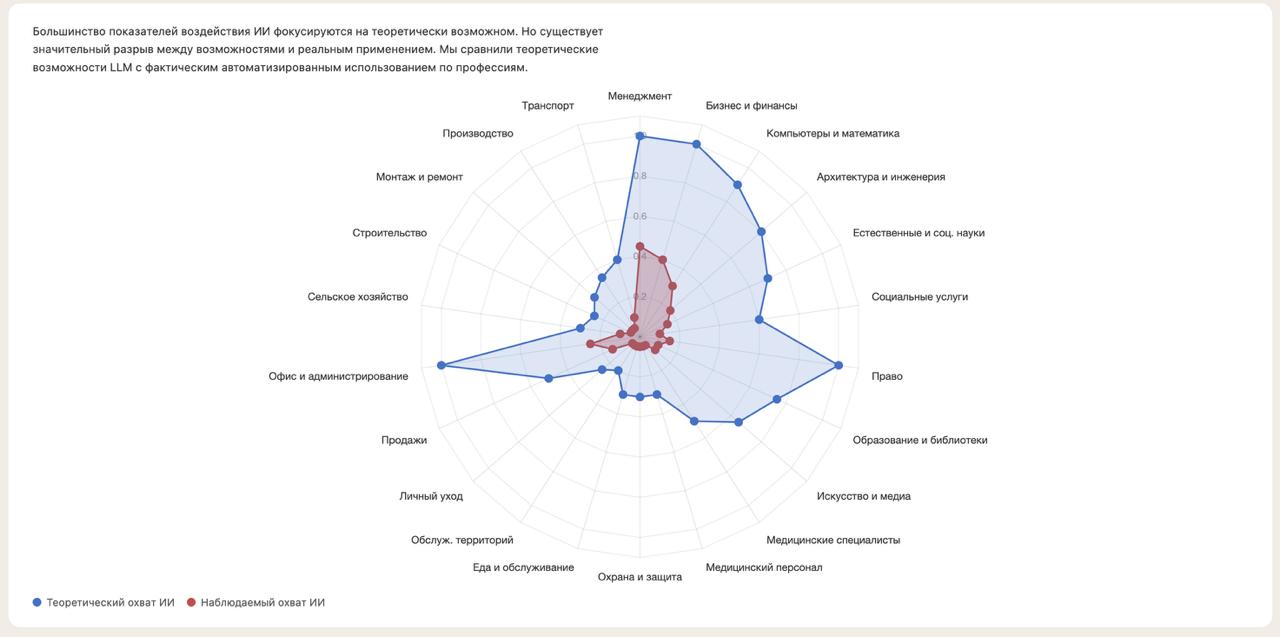
Researchers Maxim Massenkoff and Peter McCrory have introduced a metric called «observed impact.» It compares the theoretical abilities of models and Claude's actual usage. For example, in computer science and maths, AI is capable of performing 94% tasks, but is actually used to solve about 33% tasks.
In the card above, I give such a diagram by industry. It turns out that we are still at the beginning of AI use - somewhere people are just stupid and reject the technology, and somewhere (for example, in management, it is still dictated by security and data protection requirements).
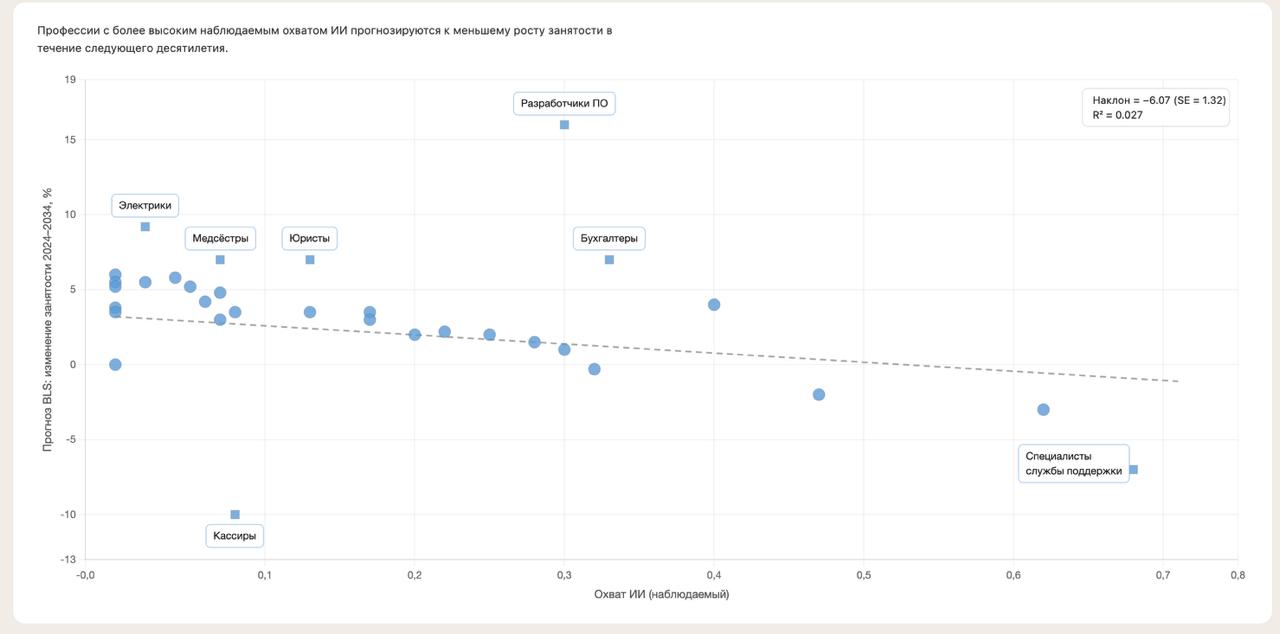
I'll tell you how to read the second chart:
Imagine you have a list of professions - cashier, programmer, accountant, lawyer, and so on. For each profession count two things:
X-axis (horizontal) - «AI coverage» - how often people in this profession are actually using AI in their work right now. 0 = almost nobody, 0.7 = very actively. It's not «could use», it's «uses it in practice».
Y-axis (vertical) - employment growth forecast - by how many percent the number of jobs in this occupation will increase (or decrease) over the next 10 years as projected by the U.S. Bureau of Labor Statistics. On the plus side, there will be more jobs; on the minus side, there will be fewer jobs.
Each point is one profession. There are ~30 such professions on the chart.
The dotted line is the trend, that is the general pattern across all points. It goes from top-left to bottom-right - this is the main conclusion of the graph:
The more active a profession uses AI today → the fewer jobs it is expected to have in 10 years.
Examples with captions:
- Cashiers - high AI coverage (≈0.2), forecast -10% → there will be significantly fewer locations
- Software developers - also high coverage (≈0.3), but forecast +16% → because AI here is more of a help than a substitute
- Lawyers and accountants are in the middle, a slight plus
Developers are the exception to the trend: they use AI a lot, but they are growing. This shows that AI does not always kill a profession - sometimes it strengthens it.
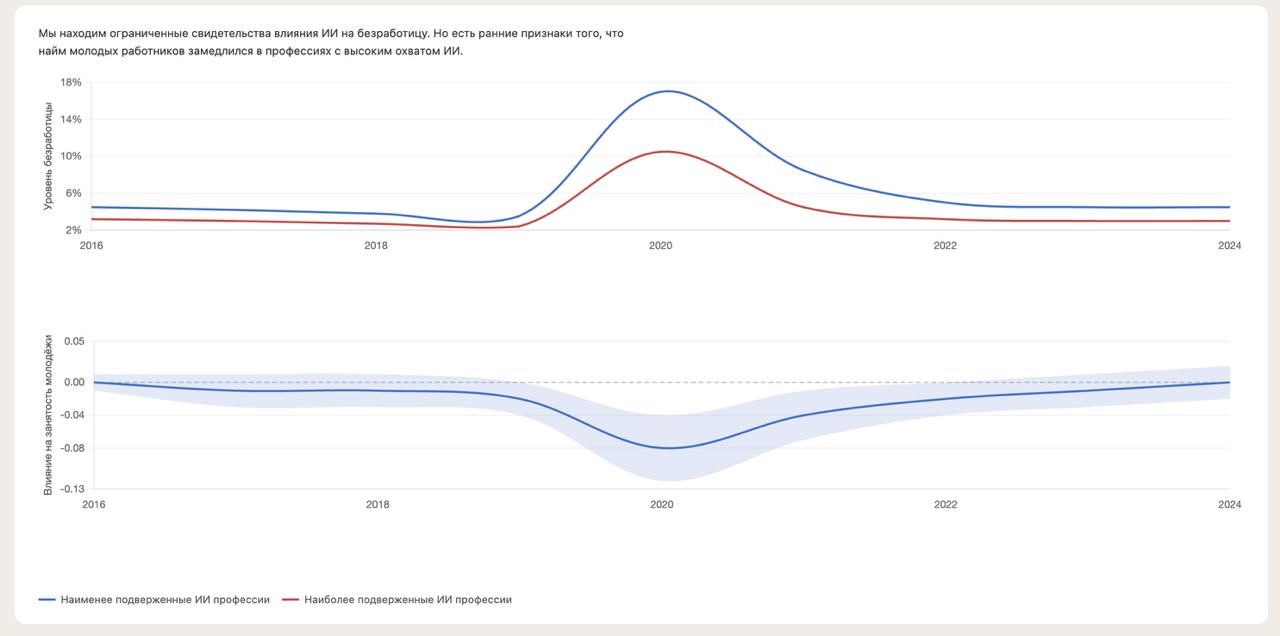
The third card is how to read:
Least exposed (blue line)
Professions with AI coverage are close to zero. They are mostly physical and manual labour: plumbers, electricians, drivers, construction workers, cooks, cleaners, nurses. Jobs that are difficult to automate through language models - because they require hands, feet, being on the spot.
Most exposed (red line)
Highly covered professions: lawyers, accountants, programmers, financial analysts, office workers, support specialists. These are those who work with text, data, documents - what LLMs do best.
Top takeaways from the study:
- AI can already perform the lion's share of all tasks in many professions, but for now there is a huge gap between “can” and “does”. So we are at the very beginning of the wave. All the most interesting things are still to come
- There's no unemployment. Yet. Researchers have found no systemic rise in unemployment among workers in the most vulnerable occupations from the end of 2022.But that's no reason to relax - see next item.
- Young professionals 22-25 years old with no experience are no longer needed. A related study documented a 6-16% drop in hiring among workers 22-25 years old in occupations with high AI coverage.
P.S. We really don't care about killing professions by evil AI right now, the internet would be left altogether