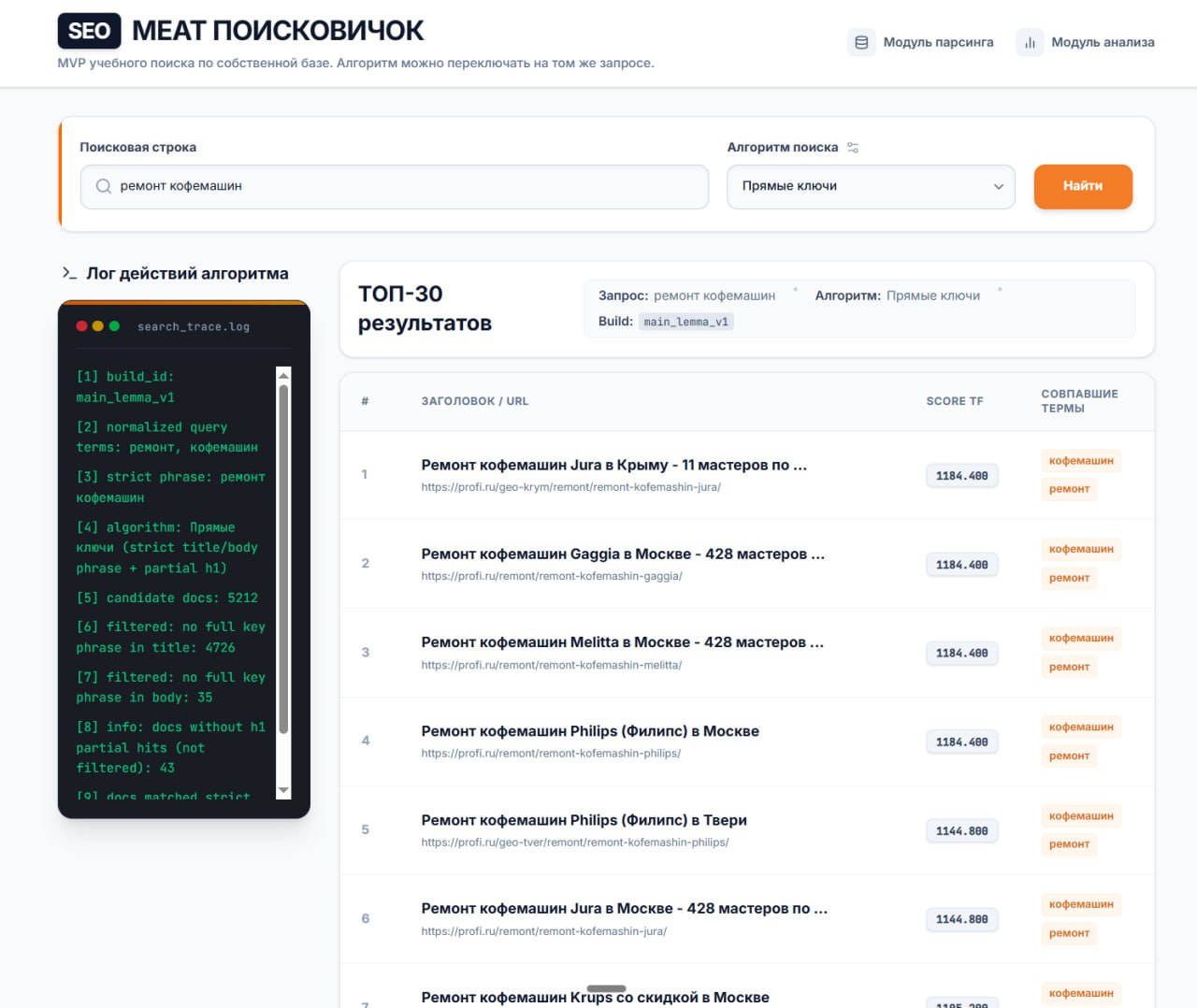
Made a mini-search engine to demonstrate the work of search algorithms in lessons through Cursor — in about 5 hours.
This post is not about «look how smart I am and made a search engine, only I can do that», but about «look how smart AI is: they made a project that I would never have started for the sake of 5 educational videos».
Why this was done
Initially, it was conceived as a pet project for my system design training, but thanks to modern coding models, everything went surprisingly smoothly — and as a result, a demonstration search engine was created.
Now I have a foundation: 20k unique URLs indexed on one topic, where all types of pages are represented, a unified index database with page metrics — and I can show in training the development of search engine algorithms layer by layer.
Because I am sure: not everyone understands the basics of «how and why different factors and search engine algorithms appeared», and how the layers »candidate selection → reranking» are structured. I really want to visually demonstrate cosine similarity and common misunderstandings of it using the example of tasks «search for relevant URLs without a specially trained LM for this task».
Plus, it's useful to look at search through the eyes of search engine developers. It's clear that I will only be able to reproduce a few percent of the real algorithms and there will be many assumptions. But it's still more interesting than talking about the development of search engines only through slides and graphs.
And all this is available for just 5 hours of work + pennies for parsing the database + 15$ subscription to the cursor + pennies for tokens.
About smart AI
Since December last year, I have constantly heard that AI in coding has started to work wonders, but it feels like right now — with the release of ChatGPT-5.3-Codex and Claude Sonnet 4.6 — it has become truly accessible to a wide audience: without a deep understanding of applied software development, you can go to Cursor, connect the model, and simply ask it to make an application for you, it will be made and will work, the main thing is to understand the basics of project design.
At this stage, you somehow start to believe the words of Dario Amodei (CEO Anthropic), who says that in the next 6–12 months AI models will be able to perform most of the tasks of software engineers end-to-end.
I predict that from the capabilities of ChatGPT-5.3-Codex and Claude Sonnet 4.6 (and beyond), a lot of people will be blown away, and we will start seeing a mass of different SEO software for all possible SEO psyops.